

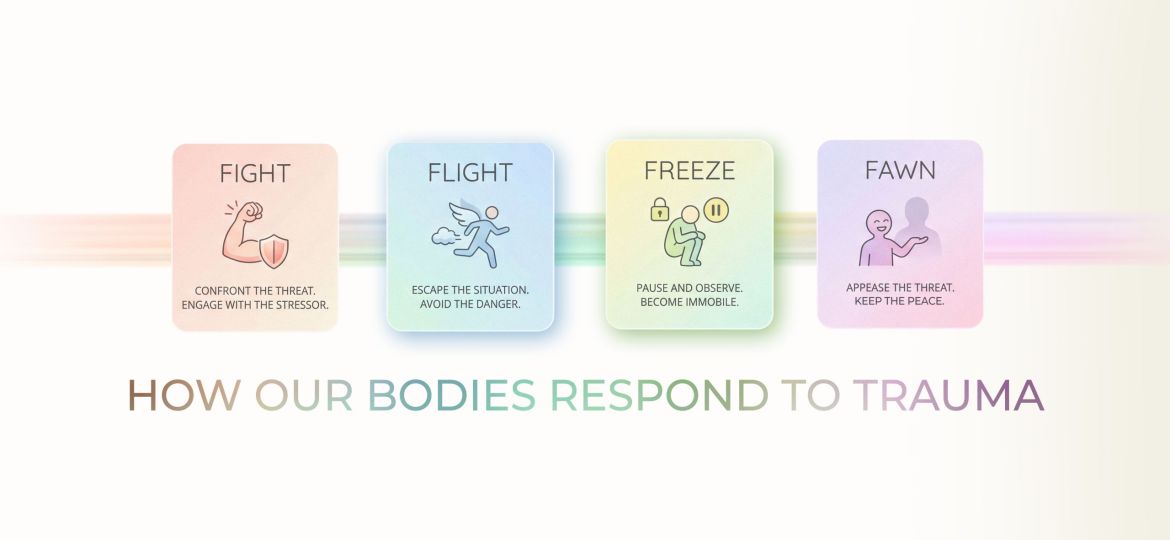
Have you ever been in a situation where something unexpected, frightening or traumatic happened, and you didn’t react the way you thought you would? Maybe you got into a car accident and instead of screaming for help or calling 911 you just…sat there, not really moving or doing anything. Responses to trauma typically fall into the following categories – fight, flight, freeze, or fawn.
What is a Trauma Response?
We are biologically designed to detect danger and to do what is needed to avoid it and remain safe. A trauma response is how we react when our mind and bodies deem something as a threat – whether it’s something that’s happening to us or something we are witnessing. A trauma response can be triggered by a noise, a person, something we see, a smell or even just a feeling or instinct.
Trauma responses can occur even when there is no real threat, but our nervous system interprets something as a threat.
Fight Trauma Response
The fight response occurs when you confront the perceived danger, often directly. This may look like physically resisting, hitting, punching, or kicking an attacker, calling 911, or any other attempt to overpower the attacker, whether that be physically or verbally. While this can be a useful response during a traumatic event, it can also be dangerous as it can lead to an escalation in violence.
After the trauma, survivors might feel irritable or annoyed, as well as easily or disproportionately angered. When this response is triggered outside of a traumatic event, like a fight with a spouse, this can lead to unhealthy dynamics in relationships.
Flight Trauma Response
The flight response occurs when you are trying to get away from the source of the danger whether that be a person or a location. This response often manifests in running away, trying to hide, or even making an excuse as to why you need to leave to subtly create distance between you and the threat.
After the trauma, survivors might stay busy, avoid reminders of the traumatic event, or struggle with anxiety and restlessness. Some survivors cope by moving frequently, changing jobs often, or distancing themselves from others. All of these are attempts, sometimes subconsciously, to escape the feelings and reminders associated with the traumatic event.
If you have experienced sexual abuse or grooming as a child, contact us confidentially today.
Freeze Trauma Response
The freeze response happens when you don’t move, don’t really react and essentially shut down during a traumatic event. Many survivors of sexual abuse have experienced this during assault. This response often occurs when the victim realizes they cannot overpower the abuser and there isn’t a feasible opportunity to escape. Freeze tends to be the next “go to” trauma response.
After the trauma, survivors might have difficulty making decisions, feel emotionally “stuck” or disassociate, especially during stressful times. This response can cause survivors to regress in their maturity and act younger than they are. This phenomenon is rooted in a need to “go back” to a time before the trauma occurred.
Fawn Trauma Response
The fawn response occurs when the victim tries to appease the perpetrator, beg them to stop, or appeal to their humanity. This persuasion-based response may occur more often in domestic violence situations or other scenarios where a perpetrator has control over a victim for a longer period of time. Fawn is a trauma response that is also very common with people who grew up in abusive homes, where they learned to minimize abuse by keeping quiet, agreeing with the abuser, and not voicing their own opinions.
After the trauma, survivors may be conflict-avoidant and participate in people-pleasing actions to a detrimental level. They have learned how to “keep the peace” which often comes at the expense of voicing their own needs, feelings, or boundaries. This also can be detrimental to their career and impact how they communicate at work.
If you have any questions regarding child sexual abuse or need additional resources, visit our questions and answers page.
How To Calm the Nervous System
While we can’t always control the trauma response that naturally manifests in a stressful situation, there are steps we can take to try to calm our nervous system. Below are some grounding techniques for when you are in a stressful, but not life-threatening situation:
- Breathing techniques. There are multiple breathing techniques that can calm your nervous system.
- 5,4,3,2,1 Technique. This grounding technique helps you to focus more on the things around you instead of what you are stressed about internally.
- 5 – See: Look around and identify five things you see.
- 4 – Feel: Identify four things you can feel or touch.
- 3 – Hear: Notice three different sounds.
- 2 – Smell: Identify two things you can smell (or would like to smell).
- 1 – Taste: Identify one thing you can taste (or last tasted).
- Have you ever heard the quote, “You should sit in meditation for 20 minutes a day. Unless you’re too busy, then you should sit for an hour.” This quote succinctly articulates how meditation can be vital in lowering stress and allowing you to focus on the present.
- Exercise lowers your stress and can help to increase the production of endorphins, which in turn can improve your overall mood.
How To Heal From Trauma
Healing does not look the same for everyone, and what works for one person might not work for the other. Below are some options to start the healing process.
- Support groups. Support groups help survivors realize they are not alone. Finding common ground in traumatic experiences can be immensely validating and help in the healing process.
- Finding a therapist can help survivors to process trauma, learn new coping skills, and potentially get prescribed medication that may be beneficial for some of their challenges.
- Exercise and diet. It has been shown that both exercise and eating healthy have a positive impact on your mental health and can lower stress. Finding ways to make improvements to your physical health might result in an improvement in your mental health as well.
- Other healthy coping mechanisms. Find other ways to destress – it might be going outside for a walk, knitting, reading, or volunteering. Whatever it is, find an activity that helps you to lower your stress and focus on the task at hand.
- Find other resources. There are many non-profits and organizations that provide free resources to survivors of abuse or people with mental health struggles. Do some research and find what fits your needs.
- Taking legal action. During abuse, victims often feel powerless. Many survivors have regained their power by filing a lawsuit against their abuser or the institution that covered up the abuse. This avenue can help survivors feel empowered and obtain a sense of justice.
While trauma responses can follow with many emotions that are often uncomfortable, there is hope for healing. The more information and understanding people have about trauma responses and healthy coping techniques, the more they can heal.
You Are Not Alone. Jeff Anderson & Associates is Here to Help
If you have survived child sexual abuse at the hands of a priest, teacher, or coach, it is not your fault. Reach out to us for a compassionate conversation about your legal options.